Sennheiser HDB 630 Review: Sound Quality King!
The Sennheiser HDB 630 is one of the best-sounding noise-cancelling headphones I have tested, with an unusually balanced tuning and excellent EQ tools. It is not perfect, and I still think the Momentum 4 offers better value.

By James · Picky Audio
· 8 min read
FINAL SCORE
89.5/100
QUICK TAKE
- SCORE
- 89.5/100
- RANK
- #2 of 26 headphones
In this Sennheiser HDB 630 review, I found a headphone that puts sound first. Its balanced stock tuning is smooth, detailed and relaxing, while the parametric EQ gives you more room to tailor it than almost any rival.
Buy the HDB 630 if that balanced tuning and sound customization are what you want. If you prefer better value, I would still go for the Sennheiser Momentum 4. If comfort, call quality and noise cancelling are the priority, I would look at the Sony WH-1000XM6 or Bose QC Ultra Gen 2 instead.
THE SCORECARD
How the Sennheiser HDB 630 scored
- RANK
- 2of 26 headphones
- CATEGORIES
- 10
- RETAIL
- Retails for $499.
- STRONGEST
- 10Battery life
- WEAKEST
- 7.5A transparency mode
Build quality and fit
8.5/10The HDB 630 has slightly roomier ear pads than the Momentum 4, but its silver plastic finish feels a bit cheap for the price.
Battery life
10/10It has 60 hours of advertised battery life with noise cancelling on.
Controls
9/10The touch controls work reliably with practice, although volume adjustment can be a little finicky.
Connectivity
9.5/10The included BTD700 dongle and wired USB-C or auxiliary options add flexibility, despite some dongle features not working in my testing.
Call quality
8/10Call quality is pretty solid overall, but it struggles more in my windy city simulation.
App customization and extra features
9.5/10The standout is the five-band parametric EQ, backed by useful extras including crossfeed, sound zones and codec information.
Noise cancelling
8/10Noise cancelling is good enough and improves on the Momentum 4 with voices, though cheaper alternatives can block more noise.
A transparency mode
7.5/10It has low occlusion and little white noise, but voices are slightly muffled and wind handling is a mess outdoors.
Sound extras
9.5/10It offers low sound leakage, wired listening options and EQ settings that save across listening modes.
Sound quality
10/10Its fast, clean bass, natural mids and smooth treble make this the best-sounding headphone of the year for me.
The Pros and Cons
PROS
- Rare balanced stock tuning with clear, natural vocals
- Excellent parametric EQ and app customization
- 60-hour advertised battery life with noise cancelling on
- Roomier ear pads and a firmer case than the Momentum 4
- Included BTD700 dongle and wired USB-C or auxiliary listening
CONS
- The plastic silver finish feels cheap for a $499 headphone
- Fit can be loose, particularly on smaller heads
- Some BTD700 functions did not work in my testing
- Transparency mode picks up wind very easily
- The Momentum 4 remains the better-value option
How comfortable is the Sennheiser HDB 630?
I scored build quality and fit at 8.5 out of 10. The HDB 630 is essentially the Momentum 4 design with a different coat of paint, protein leather on the headband and thicker ear cups for its new driver and internals.
At 311 g, it is 20 g heavier, but I found it more comfortable because the ear pads are slightly more spacious. My ears still touch inside the cups, although I got used to it and could wear the headphones for long periods. Clamping force is light, so they can move slightly if I lean over and may feel loose on a smaller head.
The hard case is a small improvement over the Momentum 4 case. It is firmer, has extra storage compartments and gives the headband and ear cups more support, although it is still chunky.
Battery life, controls and connectivity
Battery life gets a 10 out of 10. Sennheiser advertises 60 hours with noise cancelling on, matching the Momentum 4. A 10-minute charge is advertised to provide 7 hours of playback, while a full charge takes 2 hours.
Controls score 9 out of 10. The touch gestures work fine once you are precise with them, and the right ear-cup wearing sensor is very responsive. The volume gesture is the one part I found a bit finicky. On my iPhone 15 Pro, play and pause through the BTD700 randomly failed, while fast-forward and rewind did not work. Play and pause did work on my M1 MacBook Pro.
Connectivity scores 9.5 out of 10, mainly because Sennheiser includes the BTD700 dongle. The headphones support Bluetooth 5.2, SBC, AAC, aptX, aptX Adaptive and aptX HD. The dongle uses Bluetooth 5.4 and also supports aptX Lossless and LC3 or LE Audio, but the HDB 630 itself does not support aptX Lossless.
In my testing, I only got 24-bit/48 kHz from the dongle despite changing settings and checking its indicator light. Codec switching and microphone mute on the dongle also did not work for me on my iPhone 15 Pro. The dongle’s low-latency mode was its biggest benefit, looking close to 100 milliseconds in my quick iPhone test. If you genuinely want lossless or high-resolution playback, plug in through USB-C or auxiliary.
Are calls, noise cancelling and transparency good enough?
Call quality scores 8 out of 10. It is basically on par with the Momentum 4 and pretty solid overall, but it does struggle in my simulation of city, construction and wind noise.
Noise cancelling gets 8 out of 10. It blocks voices slightly better than the Momentum 4, although plane noise was about the same. Headphones including the Sony ULT WEAR and soundcore Space One Pro can offer stronger noise cancelling for less money.
I do like the ability to set noise-cancelling strength down to a single percent, even if that level of adjustment is a little unnecessary. The automatic wind reduction mode is useful because the microphones pick up wind easily. There is also barely any EQ shift between noise cancelling, noise cancelling off and transparency.
Transparency scores 7.5 out of 10. Occlusion is low, so my own voice did not sound overly blocked up, and white noise is minimal even at full strength. Voices are a little muffled and bassy, though, and wind can make the mode rapidly turn on and off outside. On a moderately windy day, I would rather turn both transparency and noise cancelling off.
Why the HDB 630 has the best EQ tools
App customization and extra features score 9.5 out of 10, largely because of the EQ. The HDB 630 has the same five-band EQ as the Momentum 4, but adds a five-band parametric EQ where you can adjust frequency and Q factor, use high or low shelves, and undo or redo changes.
I liked being able to bypass an EQ and compare it with stock tuning, or compare two EQs. You also get crossfeed for blending the left and right channels, sound zones that apply custom settings by location, Find My Headphones, active codec information and customizable app tiles.
A parametric EQ does not mean you can turn these into an over-the-top bass-head headphone. As you increase each band, total volume is reduced to help reduce distortion, and you can only steer so far away from the stock tuning. Still, the stock tuning is so good that you can make it a little more dynamic or cleaner without losing what makes it special.
How does the Sennheiser HDB 630 sound?
Sound quality gets a 10 out of 10. I gave the HDB 630 my best-sounding headphone award for 2025, although it is not my personal favourite sound signature. What Sennheiser has done here is genuinely rare in the noise-cancelling headphone market: a proper balanced tuning.
Bass is fast, clean and punchy. Sub-bass and mid-bass are present without becoming over the top or bloated. The mids are the real standout, with vocals that sound clear, natural and realistic. Upper mids are smoothly boosted, while the treble gives you good detail without sibilance or fatigue.
This is a dream if you want that natural, balanced tuning. I personally like slightly more energy, so I use the bass boost preset. It makes the sound more V-shaped while remaining clean and smooth, and it ends up sounding similar to the Momentum 4 stock tuning, just cleaner with better detail, separation and vocal separation.
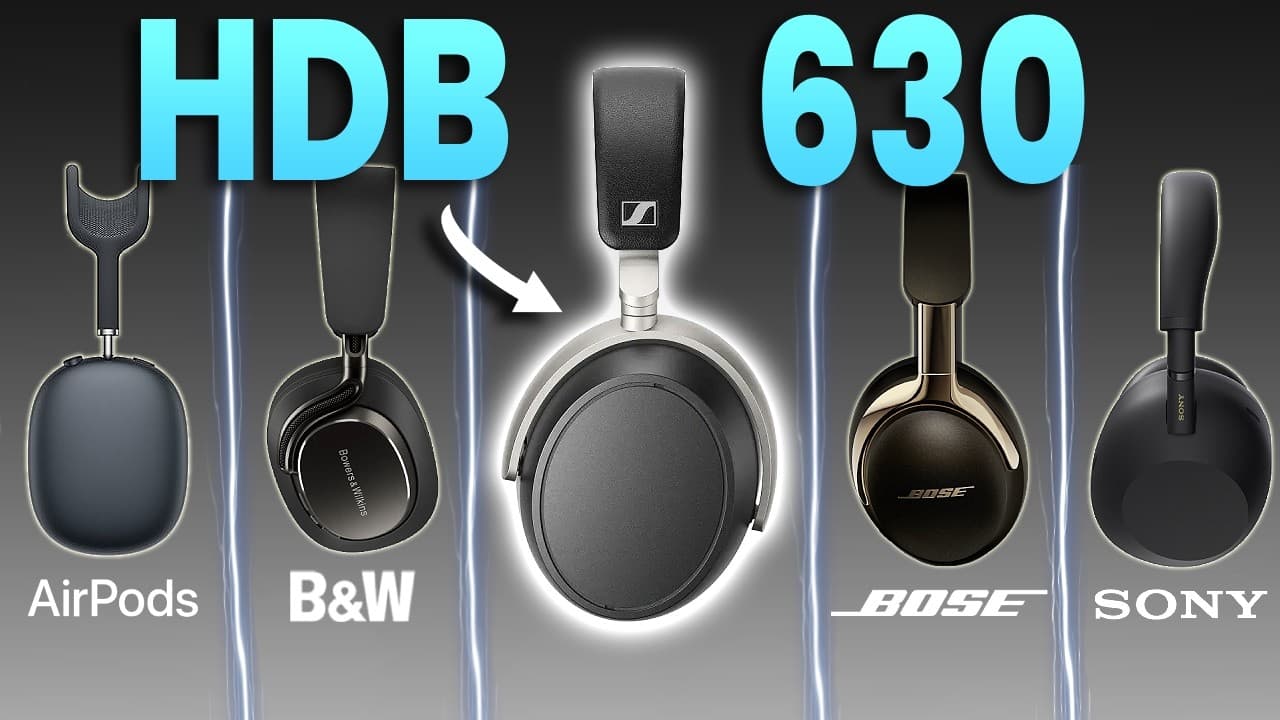
The Bowers & Wilkins PX8 S2 remains my personal favourite sounding headphone. It has more bass, crisper and airier treble, and a wider, more open soundstage. The two headphones have distinct tunings, and EQ will not make them sound alike. I would also put the AirPods Max just behind the PX8 S2 and HDB 630 for sound quality.
Sennheiser HDB 630 value and ranking
The HDB 630 finished in second place out of 26 headphones with 89.5 out of 100. It is almost four points ahead of the Momentum 4, helped by the roomier ear pads, upgraded case, slightly stronger voice reduction, parametric EQ, balanced sound and included dongle.
Those are a decent collection of minor upgrades, so the value may be there for you. I still think the Momentum 4 is the better-value headphone. The HDB 630 earns its place if you specifically want the smooth, detailed and relaxing balanced tuning, rather than just a broadly capable noise-cancelling headphone.
THE VERDICT
Sennheiser focused on sound quality with the HDB 630, and it delivered. The rest of the feature set is good enough, but the smooth, detailed, relaxing tuning is the reason to buy it.
If you know balanced stock tuning is exactly what you are after, you are going to love the HDB 630. If you want more value, get the Momentum 4. Stay picky.
Everything mentioned in this review
TAGS
Disclaimer: As an Amazon Associate I earn from qualifying purchases.