The method · 10 categories · 100 points
How I
Score.
A transparent look at how I test and rank every pair of earbuds and headphones I review, and the spreadsheets that let you re-rank them by what matters to you.


Headphones
01 — Why
Why I built a scoring system
I test a lot of earbuds and headphones. A scoring system does two things for me: it keeps every review honest and consistent against the last one, and it lets me compare products at any price, a $30 pair against a $300 pair or this year's release against a competitor from two years ago.
It also means I'm not the only one deciding what “best” means. Everyone weighs things differently. Someone who takes calls all day cares about mic quality more than bass response. Someone running outdoors cares about how secure the fit is more than noise cancelling. My scoring prioritises the most common categories, but the spreadsheet is built so you can easily change that.
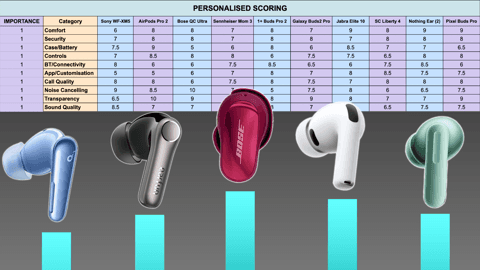
One thing this system has taught me: expensive doesn't always win. Because everything is scored on the same scale regardless of price, it's not unusual to see a $50 pair outscore a $200 pair once you weight for what you actually care about.
02 — The types
The four ways I test
Not every product gets tested the same way, because not every product is used the same way. I split earbuds and headphones into four types, each with its own dedicated scoring spreadsheet, and each with its own set of scoring categories tailored to that type.
- 0110 categories
True Wireless Earbuds
Everyday, general-purpose buds across any price range.
See all 10 - 0212 categories
True Wireless Sports Earbuds
Built and tested around training, running, and workouts.
See all 12 - 0310 categories
Open Earbuds
Clip-on and hook-style buds that don't seal the ear canal.
See all 10 - 0410 categories
Noise Cancelling Headphones
Over-ear ANC headphones.
See all 10
Speakers are the exception. I don't run speakers through a numeric scoring system. I still test every speaker just as thoroughly, comparing sound samples side by side against similarly priced or similarly sized competitors, but the results are qualitative rather than a score out of 100. More below.
03 — The 100-point score
Ten categories, ten points each, and it changes by product type
Every product gets scored across 10 categories, each rated out of 10. Add them up and you get a score out of 100.
But the ten categories themselves aren't fixed. They change depending on what the product actually is. Open earbuds don't seal your ear canal, so there is no need for noise cancelling or a transparency category. In their place, sound quality gets tested twice instead of once: once under 60% volume and once above it, because that's exactly where the open bud tuning is hardest to get right. Bass can easily distort or sound lacking at higher volumes.
It’s only the sports category that gets 12 categories. With a focus on how the buds suit different types of training such as running or weight training. Dust and water resistance is also in there as this is a higher priority for outdoor exercise.
- Comfort—Bud size and weight, ear-tip options, and hours-long wear.
- Security—Weight training and running, plus how far the buds shift.
- BT/Connectivity—Codecs, multipoint, mono mode, and measured game latency.
- Call Quality×5Three recorded scenarios on a real phone call.
- Case/Battery×5Hours in the buds and in the case, fast and wireless charging.
- Controls×5Pinch, tap and swipe — and what still works with one bud in.
- App/Extras—EQ bands, spatial audio, fit tests, find-my and firmware.
- Noise Cancelling×5Strength across frequencies, wind pickup, and EQ shift.
- Transparency×5Clarity, occlusion, and how natural your own voice sounds.
- Sound Quality×10Measured max volume, then stock tuning and my own EQ.
Sound Quality carries the most weight here by default, at ×10. Call Quality, Case/Battery, Controls, Noise Cancelling and Transparency each count for ×5.
04 — Call quality
The same three tests, every time
Every review type runs call quality through the same three real-world scenarios, recorded on an actual phone call rather than simulated in software.
Recorded on a real call · not simulated in software
Every sample is recorded on an actual phone call, not into a voice recorder — and each one is played back against the highest-scoring product I have tested.
05 — Make it yours
You can re-rank everything yourself
Each spreadsheet has an “importance” column next to every category. Type in a number, and it multiplies that category's score for every single product in the sheet, then the whole list re-sorts instantly.
Some of that weighting is already built into the ranking you see in my videos by default. Take True Wireless Earbuds: Sound Quality already counts for ten, while Call Quality, Case/Battery, Controls, Noise Cancelling and Transparency each count for five. That's my own priority order. If yours is different — say mic quality matters more to you than battery life — you just lower Case/Battery's multiplier and raise Call Quality's, and every product on the sheet re-sorts around your priorities instead of mine.
Live sandbox · True Wireless Earbuds
- ×1
- ×1
- ×1
- ×5
- ×5
- ×5
- ×1
- ×5
- ×5
- ×10
- 187.4AirPods Pro 3$249—
- 285.4Galaxy Buds4 Pro$219—
- 382.3Jabra Elite 10 Gen 3$199—
- 477.2Nothing Ear (3)$179—
- 576.2Soundcore Liberty 5$89—
- 669.0EarFun Air Pro 4$69—
Demo scores, for showing the mechanic — not published review scores. Only “My default” is my own weighting; the other three are starting points to try. Arrows show movement against my default ranking.
A pair of earbuds scores 8/10 on Sound Quality. At the default ×10 weight that one category pulls harder on the total than any other on the sheet. Drop it to ×1 and raise Comfort to ×10 instead, and you'll likely see a completely different pair jump to the top — one built for wearing all day rather than one built to sound its best at volume.
This is also how I compare products myself: against their previous generation, against a strong competitor, or against a cheaper alternative that might do 90% of the job for half the price.
06 — Speakers
A different approach
Speakers don't get run through the same 10-category, out-of-100 system. I still test every speaker rigorously, but instead of forcing a single number onto something that's inherently about taste, I compare sound samples directly against similarly priced or similarly sized competitors so you can hear the difference for yourself rather than take my word for a score.
07 — The spreadsheets
Get the spreadsheets
A spreadsheet for each type of earbud and headphone, and for each price bracket, holding every product scored so far.
These download as .xlsx. Open them in Google Sheets — the custom weighting only recalculates there.
 Budget EarbudsDownloads: 45,000+True WirelessDownloads: 100,000+
All True Wireless Earbuds
Every true wireless earbud I've tested, at any price. Current releases, older buds, and an under-$130 tab.
 Budget EarbudsDownloads: 13,000+
 HeadphonesDownloads: 12,000+
All Noise Cancelling Headphones
Every noise cancelling headphone I've tested, with scores, notes and specs.
 HeadphonesDownloads: 9,000+
 SportsDownloads: 7,000+
 Semi In-EarDownloads: 6,000+
 Open-EarDownloads: 2,500+
All Open-Ear Buds — Clip & Hook
Every open-ear bud I've tested — both clip-on and ear-hook styles.
 Open-EarDownloads: 7,000+
 Open-EarDownloads: 5,000+
 Budget EarbudsDownloads: 3,500+
 Budget EarbudsDownloads: 2,000+
FAQ
Questions I get a lot
Why do earbuds have different scoring categories than headphones?
Because they're built and worn differently. Open earbuds, for example, don't seal your ear canal, so noise cancelling and transparency aren't relevant. Sound quality gets tested twice instead, once under 60% volume and once above it, since that's where tuning is hardest to get right on that style of bud.
Do I have to use your weighting, or can I change it?
You can fully customise it. Every category has an importance multiplier you can edit yourself, and the ranking updates automatically.
Why don't speakers get a score out of 100 like earbuds and headphones?
Speaker performance depends heavily on room and personal taste in a way that's harder to reduce to a single fair number. I test speakers just as thoroughly, but I present it through direct sound comparisons rather than a score.
Why does a cheaper product sometimes rank higher than an expensive one?
Because every product is scored on the same categories regardless of price. Once you weight things toward what matters to you, cheaper options often hold their own, or win outright, against pricier competition.
How is call quality actually tested?
Every product goes through the same three real phone-call recordings: a quiet room as the baseline, simulated crowd noise, and a windy city scenario with construction noise added, the hardest of the three to pass.
How often are the spreadsheets updated?
I update them as I test and review new products, so a spreadsheet may include products released after the video you watched.
Now go build your own ranking
Download the sheet for the type you're shopping for, set the importance column to your priorities, and let the list re-sort itself.