Bowers & Wilkins Px8 S2 Review: Premium Build and Better Sound
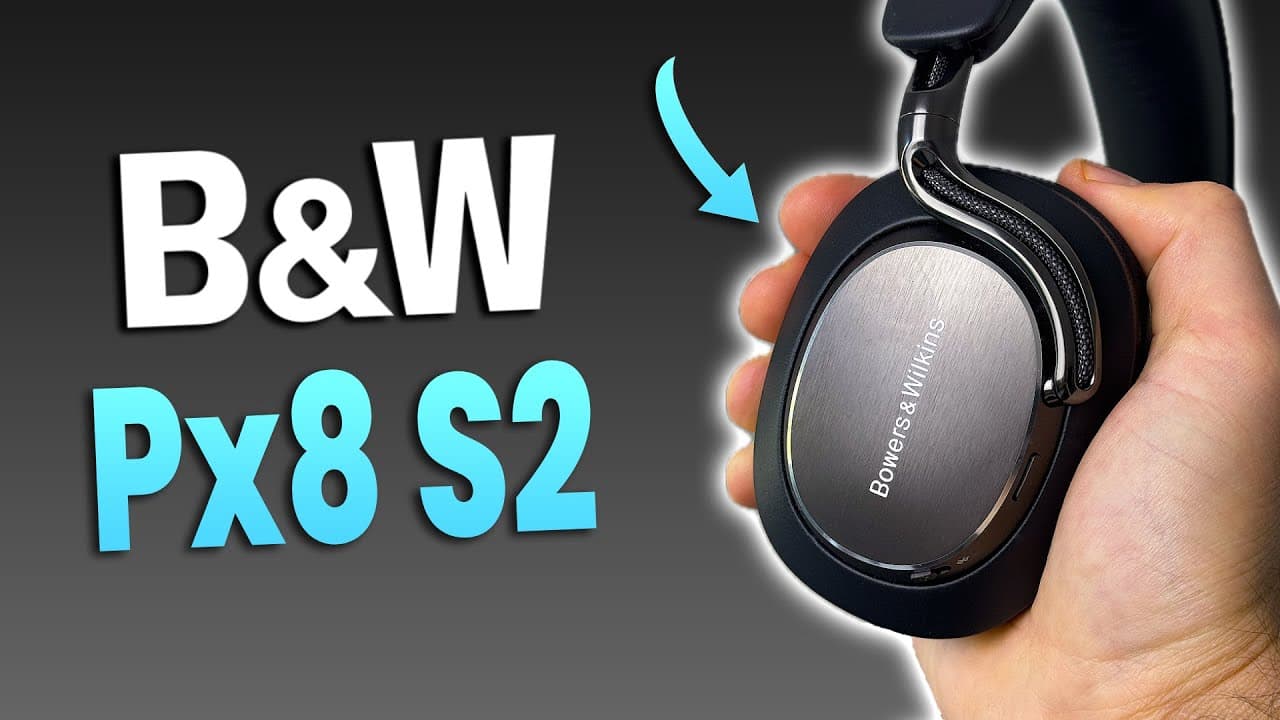
The Bowers & Wilkins Px8 S2 is a luxury flagship with my favourite build and fit of any headphone I have tested. Its sound is a subtle but meaningful step up from the PX7 S3, though the price makes it a hard sell for most buyers.

By James · Picky Audio
· 7 min read
QUICK TAKE
My Bowers & Wilkins Px8 S2 review comes down to a pretty simple decision. These are the most comfortable headphones I have tested, with an incredibly premium finish and a sound that improves on the PX7 S3 in a few important ways.
The catch is the $1,299 retail price. If you want the best build and are happy paying extra for slightly tighter bass, smoother treble and a more open presentation, the Px8 S2 makes sense. For most people, though, the PX7 S3 remains the better-value option at half the price.
The Pros and Cons
PROS
- Most comfortable headphones I have tested
- Nappa leather, brushed aluminium arms and an exceptionally premium finish
- Tighter bass, smoother treble and slightly more open sound than the PX7 S3
- Solid noise cancelling with little EQ shift
- Excellent wearing detection and useful multipoint takeover
CONS
- $1,299 retail price is hard to justify for most people
- Advertised 30-hour battery life is only average
- Transparency is slightly less amplified than the PX7 S3 to my ears
- The five-band EQ is basic for a flagship headphone
- Voice-assistant control requires sacrificing the noise-control quick button
Key details discussed in my review
| Retail price | $1,299 |
|---|---|
| Advertised battery life | 30 hours with noise cancelling on |
| Quick charge | 15 minutes for 7 hours of playback |
| Bluetooth | Bluetooth 5.3 |
| Multipoint | Two-device connection with multipoint takeover |
| Wired connections | USB-C to USB-C or USB-C to 3.5 mm cables included |
| EQ | Five-band EQ |
Are the controls and connectivity any good?
The physical controls are the same as on the PX7 S3, and they work great. The right ear cup has clicky buttons, while the old-school power switch also enters pairing mode when held up. A multifunction button on the left switches between noise cancelling, off and transparency.
I would still like the option to choose only two of those three noise-control states. Adding voice-assistant control also means sacrificing that noise-control button, which feels unnecessary when a double tap could have handled it.
Wearing detection is excellent here. Either ear cup can be lifted slightly to pause music, and playback resumes almost instantly when I put it back on. I had no issues with it on the Px8 S2, and sensitivity settings are available if you do.
Multipoint is properly flexible. I could connect two devices, let playback automatically take over from the other device, or use the headphones wired while remaining connected to a Bluetooth device. USB-C to USB-C keeps media controls, noise control and charging available; USB-C to 3.5 mm will not work if the headphones have no battery.
Call quality and app features
Call quality is broadly on par with the PX7 S3. The Px8 S2 is not as loud in my quiet-room test, which helps avoid distortion, and overall I would call its call quality decent across my quiet room, crowd-noise and windy-city simulations.
The Bowers & Wilkins app is very simple. It gives you noise-cancelling and transparency controls, a five-band EQ, paired-device management, quick-button customization, auto standby and wearing-detection toggles. The EQ offers decent freedom, but I would expect eight or 10 bands from a brand at this level.
How strong are the Px8 S2 noise cancelling and transparency modes?
Noise cancelling is very solid, and I think the Px8 S2 is ever so slightly stronger than the PX7 S3 despite what appears to be the same advertised system. It blocks low, middle and high-frequency noise, as well as voices and fan noise, quite well.
There is barely any EQ shift between noise cancelling, transparency and off, so the sound stays consistent. I also heard slightly less wind pickup than on the PX7 S3, possibly because of the different microphone arrangement.
Transparency works completely fine, and I could easily hold a conversation in a fairly noisy environment. To my ears, though, the PX7 S3 is ever so slightly better because the Px8 S2 is a little less amplified. These were pre-release headphones, so that could be addressed with firmware. Occlusion remains low, and my own voice sounds natural rather than blocked up.
| Px8 S2 | PX7 S3 | |
|---|---|---|
| Build and fit | Nappa leather, brushed aluminium arms and slightly roomier ear pads | Incredibly comfortable and well built, but less premium than the Px8 S2 |
| Noise cancelling | Very solid, and ever so slightly stronger to my ears | Very solid, but marginally behind the Px8 S2 |
| Transparency | Works well, but slightly less amplified to my ears | Ever so slightly better to my ears |
| Sound | Tighter bass, better separation, smoother treble and a slightly more open stage | My favourite-sounding headphone before the Px8 S2, with full bass and crisp, open sound |
| Value | Focused on luxury at $1,299 | The better-value option for most people at half the price |
Does the Px8 S2 sound better than the PX7 S3?
The PX7 S3 is my favourite-sounding headphone that I have tested, and the Px8 S2 sounds very similar with minor but worthwhile improvements. The PX7 S3 uses a 40 mm biocellulose diaphragm, while the Px8 S2 uses a 40 mm carbon cone diaphragm with a re-engineered chassis, coil and motor system.
Stock tuning is slightly bass boosted, much like the PX7 S3. The sub-bass is well mannered and balanced, while there is more emphasis from roughly 60 Hz upward, giving kick drums impact, bass guitars richness and synthesised bass a weighty feel. Upper bass can get slightly bloated on the stock EQ, so I prefer dialling the bass down a little.
The EQ does not seem to boost much below 50 Hz, so you cannot really turn these into deep subwoofer-style bass headphones. The mids are rich, especially in the lower mids, though vocals sit slightly back in the mix. I like adding a slight boost to the mids and upper mids to separate vocals and instruments a little more.
Treble is the real standout. It is crisp, airy and detailed without generally becoming harsh. Hi-hats, cymbals, strings, higher female vocals, synth and electronic music all benefit, and that airy top end helps create an open soundstage for headphones.
Against the PX7 S3, the Px8 S2 has tighter bass, better instrument separation, smoother treble and a soundstage that is somehow slightly more open. It is not a massive difference, but it goes a long way.
THE VERDICT
The Px8 S2 is an improvement over the PX7 S3 in build and sound, and it is the headphone to buy if luxury materials, exceptional comfort and those small sonic gains matter most to you.
I still think the PX7 S3 is the better-value choice for most people because it costs half as much. The Px8 S2 is for someone who does not mind forking out extra money for the best build and a slight improvement in sound quality. Stay picky.
Everything mentioned in this review
TAGS
Disclaimer: As an Amazon Associate I earn from qualifying purchases.